

Why Comparing Types of Filler Brands Matters Before Your First Appointment
The types of filler brands available today span a wide range of ingredients, longevity levels, and treatment goals — and choosing the wrong one can mean underwhelming results or unnecessary risk.
Here is a quick overview of the main categories:
| Filler Type | Key Brands | Lasts |
|---|---|---|
| Hyaluronic Acid (HA) | Juvéderm, Restylane, Belotero, RHA Collection, Revanesse | 6-24 months |
| Calcium Hydroxylapatite (CaHA) | Radiesse | 12-18 months |
| Poly-L-Lactic Acid (PLLA) | Sculptra | Up to 24 months |
| Polymethylmethacrylate (PMMA) | Bellafill | Semi-permanent |
| Autologous Fat / PRP | EZ Gel, fat transfer | Long-lasting / varies |
More than 3 million people in the U.S. choose dermal fillers every year. Yet with so many brands and ingredient types on the market, picking the right one is rarely straightforward — especially when you want results that look natural, not overdone.
The good news? Each filler type has a clear purpose. Knowing the differences upfront saves time, money, and guesswork.
I’m Aisha Hasan, PA-C, a lead injector at ProMD Health Ashburn with hands-on experience across the full spectrum of types of filler brands, from HA-based options to longer-acting biostimulators. In this guide, I’ll walk you through exactly what separates each brand and ingredient so you can walk into your consultation already informed.
Understanding the Primary Types of Filler Brands
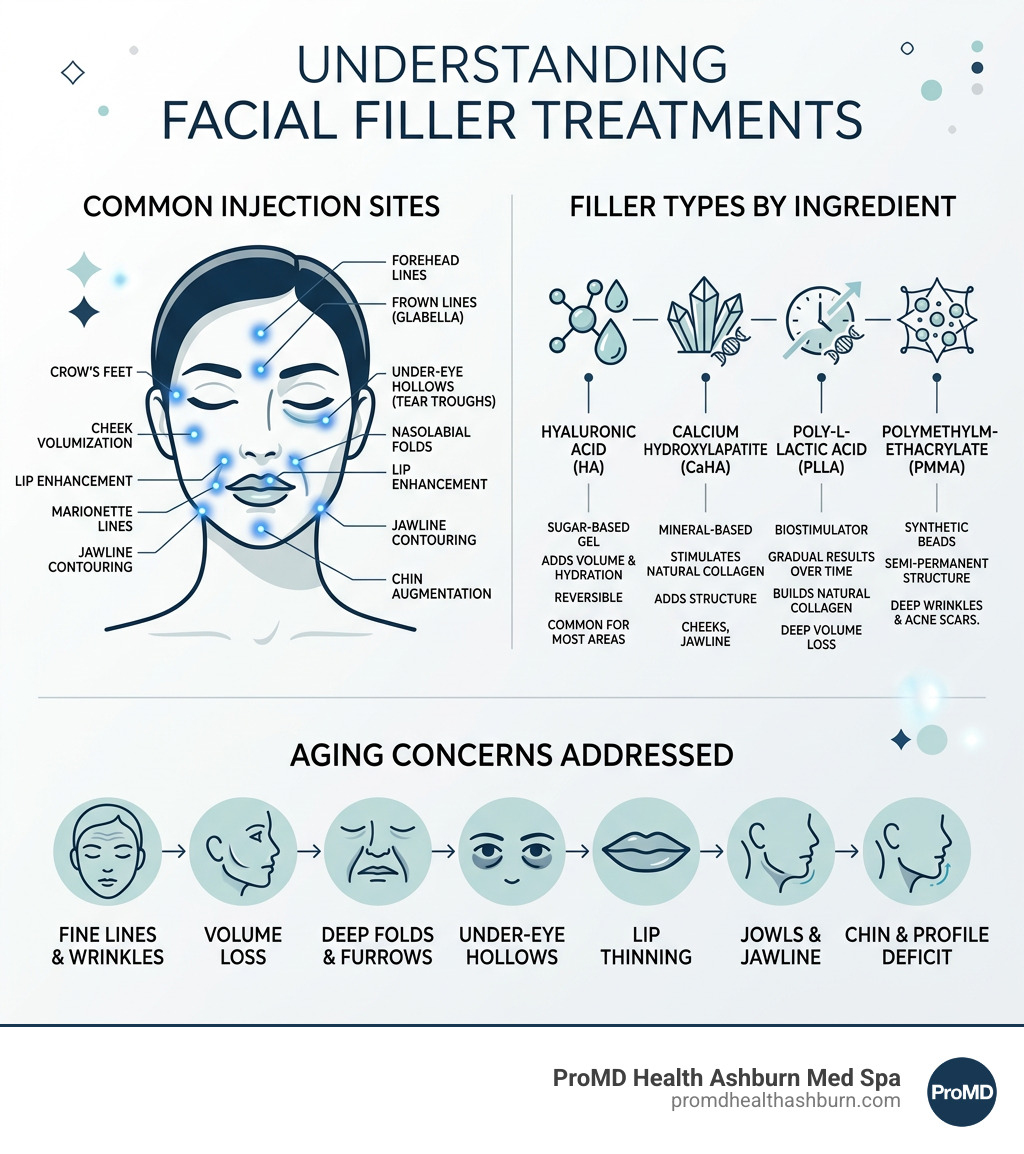
When we talk about the different types of filler brands, we aren’t just talking about different names on a box. We are talking about the chemistry of what is being injected into your skin. The primary goal of any dermal filler is to restore lost volume, smooth out wrinkles, and enhance facial contours, but the “how” depends entirely on the active ingredient.
Most fillers used at our Ashburn and Leesburg locations fall into one of four categories:
- Hyaluronic Acid (HA): This is the gold standard. HA is a sugar molecule naturally found in your skin that can hold up to 1,000 times its weight in water. Because it’s already in your body, it’s highly biocompatible.
- Calcium Hydroxylapatite (CaHA): A mineral-like compound found in bones. It’s thicker than HA and acts as a “scaffold” for your skin.
- Poly-L-lactic Acid (PLLA): A synthetic, biodegradable substance that has been used for decades in dissolvable stitches. It doesn’t just fill; it “seeds” the skin to grow new collagen.
- Polymethylmethacrylate (PMMA): A permanent synthetic substance that uses tiny microspheres to provide structural support.
According to a scientific review on hyaluronic acid and skin aging, HA is a key molecule in skin moisture and elasticity. As we age, our natural HA levels drop, leading to that “deflated” look we often see in the cheeks or under the eyes. By using these various types of filler brands, we can effectively hit the “undo” button on some of those aging signs.
Hyaluronic Acid (HA): The Most Popular Types of Filler Brands
If you are a first-timer, there is an 87% chance you will start with an HA filler. Why? Because they are incredibly versatile and, most importantly, reversible. If you decide the “pout” is a bit too much, we can use an enzyme called hyaluronidase to dissolve the filler almost instantly.
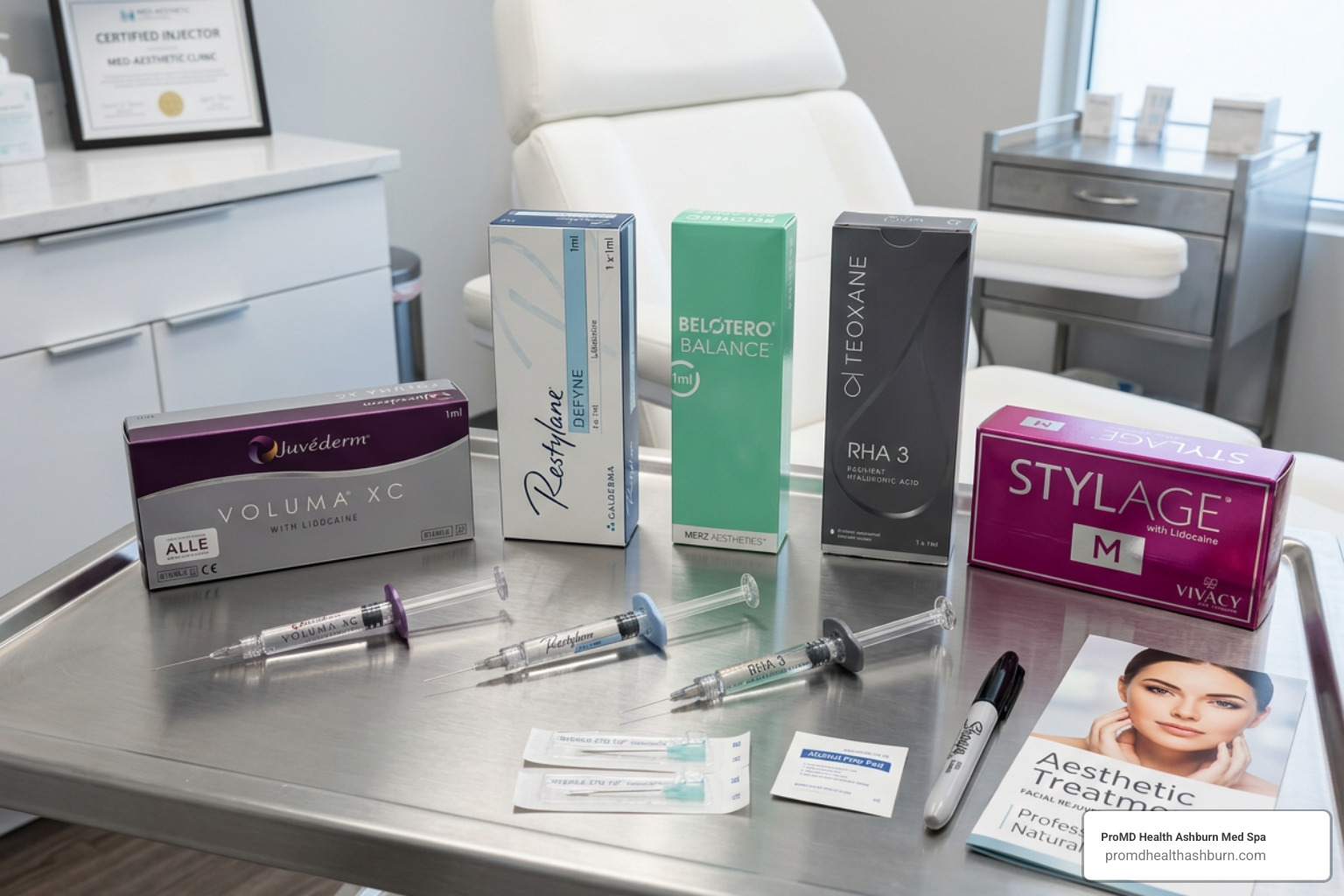
The big names in this category include:
- Juvéderm: Known for its smooth consistency and high concentration of HA.
- Restylane: Offers a range of textures, from firm “lifting” gels to soft, flexible ones for lip movement.
- Belotero: Excellent for very fine lines because it integrates so seamlessly into the upper layers of the skin.
- Revanesse Versa: A favorite for those worried about swelling, as it often results in less post-procedure puffiness.
- RHA Collection: The first fillers designed to adapt to your facial expressions (Resilient Hyaluronic Acid).
Whether you’re visiting us in One Loudoun or Lansdowne, our team focuses on matching the specific HA brand to your anatomy. You can learn more about our specific dermal filler services to see how we apply these tools.
Calcium Hydroxylapatite (CaHA) and Biostimulators
While HA fillers are like a soft cushion, CaHA fillers are more like a structural support beam. The primary brand here is Radiesse.
Because CaHA is a mineral-like compound, it is significantly thicker and heavier than HA. This makes it ideal for deeper wrinkles, like the nasolabial folds, or for contouring a weak jawline. What makes Radiesse special is its “biostimulatory” effect. The gel provides immediate volume, but the calcium microspheres stay behind to trigger your body’s natural collagen production.
Research on Neocollagenesis and Neoelastinogenesis shows that these types of fillers actually help the skin rebuild its own foundation over time. This means that even after the filler itself is absorbed, your skin may remain firmer than it was before the treatment.
Comparing Top Brands by Ingredient and Longevity
Choosing between the various types of filler brands often comes down to two questions: “Where is it going?” and “How long will it last?”
| Brand Name | Primary Ingredient | Typical Longevity | Best For |
|---|---|---|---|
| Juvéderm Voluma | Hyaluronic Acid | 18–24 Months | Cheeks & Chin |
| Restylane Kysse | Hyaluronic Acid | 6–12 Months | Lips |
| Radiesse | Calcium Hydroxylapatite | 12–18 Months | Jawline & Hands |
| Sculptra | Poly-L-lactic Acid | 24+ Months | Temple & Mid-face |
| Belotero Balance | Hyaluronic Acid | 6–12 Months | Fine lines & Tear Troughs |
| Bellafill | PMMA & Collagen | 5+ Years | Acne Scars & Deep Folds |
Juvéderm and Restylane: The HA Giants
These two families of fillers dominate the market, but they use different technologies to achieve results.
Juvéderm uses Vycross technology, which cross-links different weights of HA molecules. This creates a very smooth, cohesive gel that is easy to mold. We often use Voluma XC for the cheeks because it has the “lifting power” needed to stay in place, while Volbella is thin and perfect for smoothing out vertical lip lines.
Restylane, on the other hand, uses NASHA technology (Non-Animal Stabilized Hyaluronic Acid). This creates a firmer, more “particulate” gel that stays exactly where we put it. Restylane Lyft is a powerhouse for the mid-face and even hand rejuvenation, while Restylane Silk was the first FDA-approved filler specifically for the lips.
If you’re looking for that perfect balance of volume and movement, we often recommend lip filler options that utilize these specific “giant” brands to ensure a natural look.
Sculptra and Radiesse: Long-Lasting Collagen Stimulators
If you aren’t looking for an “instant” change but rather a gradual restoration of youth, biostimulators are the way to go.
Sculptra Aesthetic (Poly-L-lactic acid) is unique. We don’t just inject it into a wrinkle; we fan it across areas of volume loss, like the temples or the hollows of the cheeks. Over the course of three sessions, Sculptra works with your body to replace lost collagen. While you won’t see the full results for a few months, those results can last more than two years. It’s the ultimate “stealth” filler—no one will know you had anything done; they’ll just think you look rested.
For more details on this process, check out our Sculptra treatments page.
Specialized Alternatives: Fat Grafting and PRP Therapy
Sometimes, the best filler isn’t a brand at all—it’s you!
Autologous Fat Grafting involves taking fat from one area of your body (like the hips or abdomen) via liposuction, purifying it, and then injecting it into the face. Because it’s your own tissue, there is zero risk of an allergic reaction, and the results can be permanent. However, it is a surgical procedure and involves more downtime than a standard syringe of Juvéderm.
Platelet-Rich Plasma (PRP) Therapy and EZ Gel are other “natural” options. We draw a small amount of your blood, spin it in a centrifuge to concentrate the platelets and growth factors, and then inject it back into the skin. This triggers a massive healing response. While PRP doesn’t provide the same structural “plump” as a thick HA filler, it is incredible for improving skin texture and treating dark circles under the eyes.
Scientific research on treating aging layers with fillers highlights that combining these autologous treatments with traditional fillers can address aging at every level—from the bone and fat pads up to the skin surface.
Safety, Reversibility, and What to Avoid
At ProMD Health Ashburn, your safety is our absolute priority. While dermal fillers have a very high satisfaction rate (over 83%), they are medical procedures. Common side effects include mild bruising, swelling, and redness at the injection site. These usually resolve within a few days.
More serious complications, like vascular occlusion (where filler accidentally blocks a blood vessel), are rare but require immediate attention. This is why we only use reversible HA fillers in high-risk areas—we always have the “antidote” (hyaluronidase) on hand.
To help you recover faster, we follow research on minimizing bruising after injectables, which suggests avoiding blood thinners like aspirin or ibuprofen for a week before your appointment.
Navigating FDA-Approved vs. Non-Approved Types of Filler Brands
This is a big one: Never, ever buy filler online or go to an “unlicensed” injector.
The FDA has issued stern warnings against:
- Liquid Silicone: This can migrate, cause chronic inflammation, and lead to permanent disfigurement. It is not approved for facial filling.
- Needle-Free Devices: “Hyaluron pens” use high pressure to force filler into the skin. They are unpredictable, can cause tissue damage, and are not FDA-approved.
- Counterfeit Products: If the price for a syringe of Juvéderm seems too good to be true, it probably is.
Always ensure your provider is using FDA-approved types of filler brands. In our Ashburn, VA office, we only stock authentic, brand-name products sourced directly from the manufacturers (Allergan, Galderma, etc.).
Frequently Asked Questions about Filler Brands
Which types of filler brands are reversible?
Only Hyaluronic Acid (HA) fillers are truly reversible. This includes brands like Juvéderm, Restylane, Belotero, and the RHA Collection. If a patient is unhappy with the result or if a complication occurs, we can inject hyaluronidase to dissolve the product. Non-HA fillers like Radiesse and Sculptra cannot be dissolved and must be absorbed naturally by the body over time.
How long do different dermal fillers typically last?
Longevity varies by product and where it is placed. Generally:
- HA fillers: 6 to 18 months (lips wear out faster due to movement; cheeks last longer).
- CaHA (Radiesse): 12 to 18 months.
- PLLA (Sculptra): Up to 2 years or more.
- PMMA (Bellafill): Can last 5 years or longer.
What is the average cost per syringe for top filler brands?
Costs vary based on the provider’s expertise and the specific product. On average in the U.S.:
- HA Fillers: $550 to $850 per syringe.
- CaHA (Radiesse): $550 to $750 per syringe.
- PLLA (Sculptra): Roughly $900 per vial (most patients need 2-3 vials per session).
- PMMA (Bellafill): Approximately $1,000 per syringe.
Conclusion
Navigating the many types of filler brands can feel like learning a new language, but you don’t have to do it alone. The “best” filler isn’t the most expensive one or the one your favorite celebrity uses—it’s the one that matches your unique facial anatomy and aesthetic goals.
Whether you are looking to restore high cheekbones, plump your lips for a special event in Belmont, or smooth out deep folds before a big meeting in Leesburg, our team at ProMD Health Ashburn Med Spa is here to guide you.
One of the most exciting tools we offer is the Entity Med AI Simulator. This allows us to provide a personalized outcome visualization, so you can see a “preview” of your results before the first needle even touches your skin. It takes the guesswork out of the process and ensures we are both on the same page.
Ready to see what the right filler can do for you? Explore our dermal filler services and schedule your consultation today. We can’t wait to help you look and feel like the best version of yourself!