

You're looking at a photo, smiling naturally, and suddenly the fine lines at the outer corners of your eyes seem much more noticeable than they did in the mirror. You may be wondering whether they're expression lines, whether Botox will make your smile look different, or whether the treatment is appropriate if you already deal with dry eyes or wear contact lenses.
Botox for crow's feet can soften wrinkles caused by repeated muscle movement, but the best result starts with understanding what it can and can't change. Dose, injection placement, tear-film health, product choice, and your desired level of expression all matter. This guide translates the clinical evidence into practical questions to take to a consultation.
Table of Contents
- What Botox Does to Crow's Feet
- Who Makes a Good Candidate and How Dose Is Chosen
- What the Appointment Really Feels Like
- The Recovery Timeline and How Long Results Last
- Botox vs Dysport vs Daxxify and Non-Injectable Options
- The Dry-Eye Trade-Off Most Articles Skip
- Pricing, Maintenance, and the ProMD Health Ashburn Experience
- Frequently Asked Questions About Botox for Crow's Feet
What Botox Does to Crow's Feet
Crow's feet, clinically called lateral canthal lines, are the radiating creases at the outer eye corners. They become more visible when the circular eye muscle, the orbicularis oculi, contracts during smiling, squinting, laughing, or concentrating.
Botox is a purified neuromodulator. A qualified provider places it into selected muscle fibers, where it temporarily reduces the nerve signal that triggers contraction. The muscle then moves with less force, the skin folds less often, and the lines may soften. This process is explained in more detail in how Botox works for wrinkles.

Why the approval matters
Botox Cosmetic received U.S. FDA approval in 2013 for the temporary improvement of moderate-to-severe lateral canthal lines in adults. Clinical evidence supported that labeled use. In one trial, investigator responder rates were 54.9% for crow's feet alone and 59.0% for crow's feet combined with glabellar lines, compared with 3.3% for placebo. The primary and secondary endpoints reached statistical significance at p < .001. The published review and trial discussion provides the clinical context.
The approved crow's-feet regimen is 24 total units, given as 4 units at each of 3 injection sites per side, for 6 sites overall, according to the prescribing information. That labeled regimen is a reference point, not an automatic instruction for every face. Providers may adjust the plan for muscle strength, anatomy, symmetry, and the amount of movement you want to preserve.
Practical rule: The aim is relaxed motion, not an expressionless face.
Botox softens movement-related lines. It does not fill a deep groove, restore lost volume, or substantially correct sun damage and loose skin. Lines that remain visible while your face is fully relaxed may call for medical skincare, microneedling, a peel, or another option selected after examination. A careful consultation separates dynamic wrinkles from changes in texture, laxity, and volume before discussing units. It should also leave room to ask how treatment could affect the ocular surface, particularly if you have dry eyes or wear contact lenses.
Who Makes a Good Candidate and How Dose Is Chosen
A good candidate is usually an adult bothered by lines beside the eyes that become more pronounced when smiling or squinting. They should have realistic expectations and no medical reason to postpone treatment. Botox may suit someone who wants visible softening without surgery, particularly when repeated muscle movement is the main cause of the lines.
The decision needs more care when wrinkles remain deep at rest, the skin shows substantial sun damage, or the area has laxity or lost volume. Botox may still help, but it may not address every change. A responsible provider explains when neuromodulation alone is unlikely to meet your goal instead of suggesting that one treatment will erase every line.
How providers think about units
Published consensus guidance describes typical starting ranges of 8 to 16 units per side in women and 12 to 16 units per side in men. It places injections in the lateral portions of the orbicularis oculi, using 2 to 5 injection points per side, with a total range of 12 to 30 units depending on anatomy and severity. These figures guide planning, not prescribe a dose for every face. The consensus recommendations explain how muscle activity and the risk of product spreading beyond the intended area affect the plan.
A dose-response study examined 18, 12, 6, and 3 units per side and identified 12 units per side as the most appropriate dose in that study. The findings support a relationship between dose and effect, while your muscle strength, facial structure, symmetry, and preferred amount of movement still determine the final choice. The dose-response research offers useful context for that discussion.
| Dosing example | Total units | How it may be used |
|---|---|---|
| Conservative plan | Individualized | A first treatment, subtle movement goals, or greater concern about product spreading |
| Common clinical range | 12 to 32 units | Adjusted for muscle strength, symmetry, and line severity, using published starting ranges |
| FDA-labeled Botox Cosmetic pattern | 24 units | 4 units at each of 3 sites per side, as described in the product information |
Treatment should be postponed during pregnancy or breastfeeding or when an injection-site infection is active. Relevant neuromuscular conditions and medications also need review before treatment.
Because the injections are close to the eye, mention eyelid closure problems, previous eyelid procedures, contact-lens use, burning, irritation, fluctuating vision, or dry-eye symptoms. These details can affect both the dose conversation and the risk-benefit discussion, especially if your eyes already feel dry or contact lenses become uncomfortable.
What the Appointment Really Feels Like
You arrive expecting a few quick injections, but a responsible first visit starts with questions. Your provider reviews your health history, medications, previous cosmetic treatments, and goals. They also ask about burning, irritation, fluctuating vision, contact-lens intolerance, and dry-eye symptoms. These details matter because relaxing muscles around the eye can affect comfort as well as expression.
You may be asked to smile, squint, and relax your face. The provider watches how the orbicularis oculi moves, compares both sides, and may take photographs for a baseline. The injection pattern should follow your muscle activity and facial structure, rather than copy a fixed template.
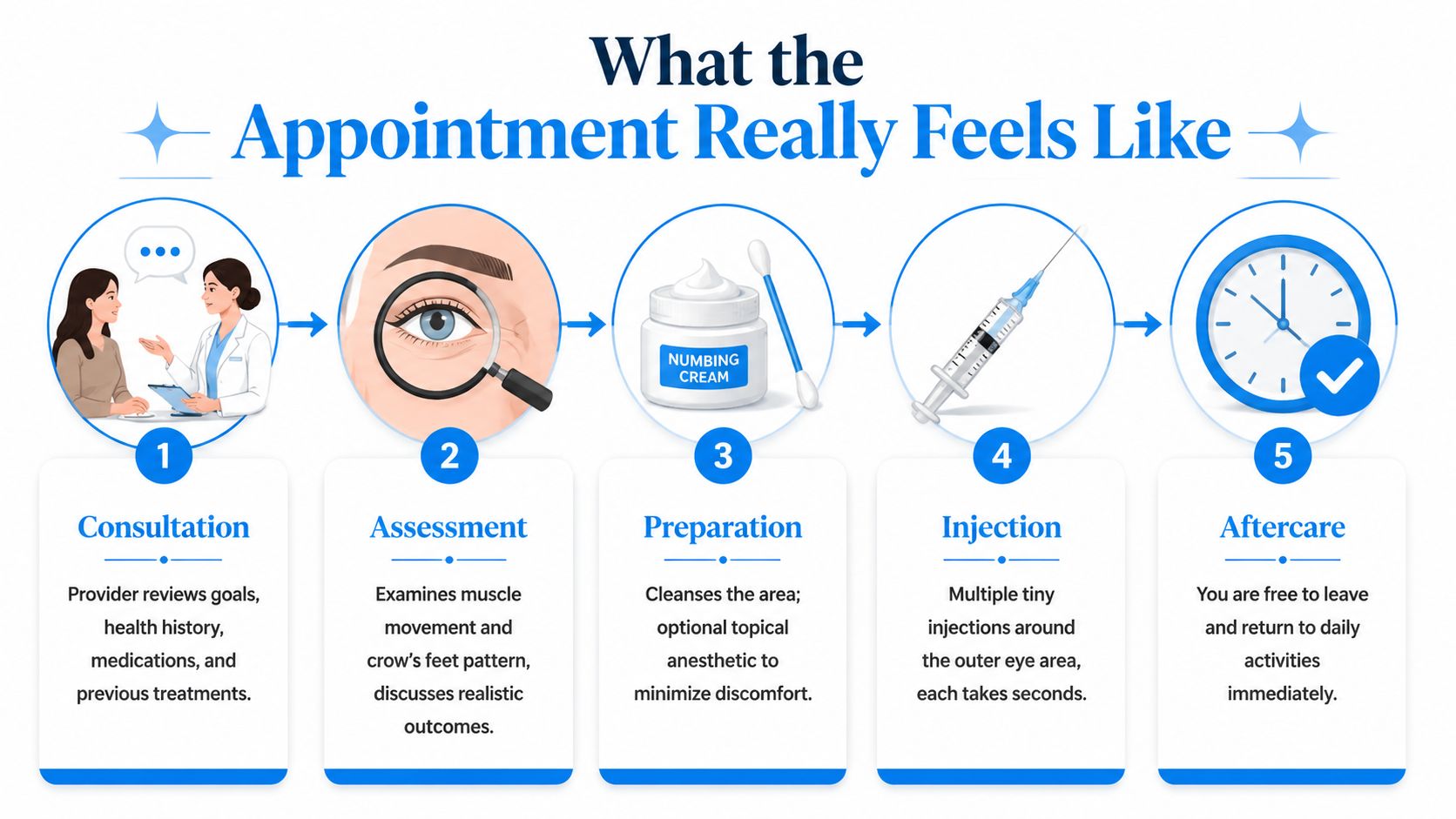
From cleansing to the final injection
After you approve the plan, the skin is cleansed, commonly with alcohol. Some practices offer topical numbing cream or a cold compress. Many patients find the procedure brief enough to manage without anesthesia.
The needle is very fine. Each injection usually feels like a quick pinch, pressure, or mild sting lasting seconds. The labeled Botox Cosmetic pattern uses 6 injection sites, 3 on each side, while your provider may choose a different number based on anatomy, movement, and dry-eye risk.
A full appointment commonly takes 15 to 30 minutes. The injections themselves may take only a few minutes, while consultation and documentation take longer. Small raised bumps, pinpoint bleeding, tenderness, redness, or bruising can occur. Gentle pressure may be applied afterward, but the area is usually not massaged.
Before leaving, confirm the planned unit count, aftercare instructions, expected onset, and follow-up timing. Ask how the plan may change if you wear contact lenses or already experience dry eye. If an important event is approaching, leave enough time for bruising or a slower response. The FDA clinical review and published evidence provides broader clinical context for treatment planning and outcomes.
The Recovery Timeline and How Long Results Last
A few hours after crow's-feet treatment, the mirror may show faint pink dots, small bumps, or mild tenderness at the injection sites. These signs usually settle as the skin recovers. Follow your provider's instructions about rubbing the area, lying down, exercise, and skincare, since aftercare can vary with the treatment plan.
During the first several days, improvement develops gradually. The outer-eye muscles may feel less forceful before the lines look noticeably softer. By the second week, many patients can better judge whether the result preserves a natural smile while reducing excessive crinkling.
What the clinical timeline shows
A phase 3 study in Chinese subjects found that 63.9% of treated patients had none-or-mild crow's-feet severity at maximum smile by day 30, compared with 5.0% in the placebo group. The effect lasted at least 5 months. The published clinical review discusses the evidence for temporary improvement.
Your experience may differ. Muscle strength, injection placement, dose, product, and the way you assess your lines all influence the timeline. An early partial response does not necessarily mean treatment failed. More units would not automatically produce a better or more natural result.
Botox for crow's feet is temporary. Clinical trial data report median response durations of 119 to 148 days, depending on study design and whether investigators or patients assessed the result. That range corresponds broadly to about 4 to 5 months for many patients. The duration data help explain why maintenance is usually planned around the return of movement, rather than a permanent correction.
Repeated treatment can remain effective. In a Japanese phase 3 study, repeated onabotulinumtoxinA treatment across up to 5 sessions over 13 months continued to reduce crow's-feet severity without new safety findings. The multicountry evidence also reports effects that remained present at 3 months in a comparative product study.
Dry-eye or contact-lens wearers should bring that concern to the consultation before scheduling maintenance. A plan that softens the lines while preserving comfortable blinking may be preferable to increasing the dose. If treatment stops, muscle activity gradually returns and the lines reappear over time. Available evidence does not support a sudden rebound process that accelerates aging.
For a broader explanation of treatment durability, read this guide to how long Botox lasts.
Botox vs Dysport vs Daxxify and Non-Injectable Options
A patient may want softer crow's feet while keeping a natural smile, or may prefer fewer maintenance visits. Those priorities can point to different neuromodulator discussions. “Botox” is often used as shorthand for the category, but Botox, Dysport, and Daxxify differ in formulation, dosing conventions, onset patterns, and published evidence. Units are not interchangeable, so the injector must choose and calculate the product-specific dose.
| Attribute | Botox, onabotulinumtoxinA | Dysport, abobotulinumtoxinA | Daxxify, daxibotulinumtoxinA |
|---|---|---|---|
| Main discussion point | Familiar product with extensive crow's-feet evidence | May suit a fan-shaped pattern when the provider's technique calls for broader spread | Newer formulation discussed when duration is a major priority |
| Onset | May begin within several days | May appear earlier for some patients | Individual response varies |
| Longevity | Temporary, with duration varying by patient and treatment plan | Temporary, with duration varying by patient and treatment plan | Newer evidence and product-specific data should be reviewed during consultation |
| Dose comparison | Units aren't interchangeable with other products | Units aren't interchangeable with Botox | Units aren't interchangeable with Botox or Dysport |
| Best consultation question | How much movement do I want to preserve? | Would the provider's chosen spread and technique suit my pattern? | Is the potential duration worth the product-specific cost and evidence discussion? |
The brand name is only one part of the result. Muscle strength, eyelid anatomy, line pattern, injection placement, and the amount of movement a patient wants to keep can matter just as much. Comparative evidence has found similar crow's-feet improvement between botulinum toxin formulations, with effects still present at 3 months. The comparative study supports discussing technique and anatomy rather than treating product selection as a simple brand ranking.
Newer formulation data add another consideration. A 2025 phase 3 study of a liquid botulinum toxin A formulation reported 71% treatment satisfaction through month 6, one-third of subjects noticing onset within 1 day, and 23% having none-or-mild lateral canthal line severity at month 6. The phase 3 findings show why onset, satisfaction, and duration should be interpreted by formulation and study design, not assumed to be identical across products.
Non-injectable options address different concerns:
- Microneedling may improve surface texture and crepey skin, but it does not relax the orbicularis oculi.
- Light chemical peels and medical-grade skincare protocols may support skin texture and tone.
- RHA fillers may be discussed for static lines or volume changes that remain when the face is relaxed.
- Upneeq addresses eyelid position, not crow's feet.
For a local comparison of available options, review Botox, Dysport, and Daxxify in Ashburn. Patients comparing consultation questions across practices may also find Swiss Botox specialists useful for understanding how providers describe treatment planning. Ask which product is recommended, how many units are planned, what movement will remain, and how dry-eye or contact-lens concerns affect the choice.
The Dry-Eye Trade-Off Most Articles Skip
If your eyes already feel gritty after a day in contact lenses, wrinkle improvement is only part of the decision. The orbicularis oculi creates expression lines, but it also supports blinking, spreads the tear film, and contributes to the pumping action associated with the meibomian glands.
A 2025 clinical study found that botulinum toxin A injections around lateral canthal wrinkles temporarily reduced tear-film stability, affected meibomian gland function, and produced corneal epithelial changes. The most concerning ocular-surface measurements appeared from about 1 week to 3 months after treatment. Because the findings do not mean every patient will develop symptoms, they are best used to guide screening and treatment planning rather than to predict an individual outcome.
Contact-lens wearers need a closer conversation. Long periods at a computer can lead to incomplete or less frequent blinking, while lenses may make dryness and irritation easier to notice. Reduced periocular muscle activity can add another factor, so comfortable vision may matter more than removing every visible line.
For contact-lens wearers: Tell your injector how long you wear lenses, whether your eyes burn or feel gritty, and whether your vision fluctuates during the day.
A cautious plan may include:
- Baseline screening: Review dry-eye symptoms, eyelid closure, contact-lens tolerance, and previous eye conditions before treatment.
- Conservative dosing: When ocular-surface symptoms or sensitivity are concerns, the clinical plan may begin around 6 to 8 units per side. This is a provider-guided starting approach, not a universal prescription.
- Lateral placement: Treat the lateral canthus while avoiding placement too close to the lower-lid margin, where unwanted weakness could affect comfort or closure.
- Supportive care: Your provider may discuss warm compresses, regular blinking, and medical-grade eyelid-support skincare when appropriate.
Patients with active or significant dry-eye symptoms do not necessarily need to rule out treatment permanently. Ask whether symptoms should be stabilized first, whether the treatment area can be adjusted, and how follow-up will address any change in contact-lens tolerance. This conversation helps balance a softer appearance with healthy, comfortable eyes.
Pricing, Maintenance, and the ProMD Health Ashburn Experience
Treatment cost depends on the product, unit count, injector's pricing, facial anatomy, and whether you select a maintenance plan. In the planning model described here, Botox is priced at $10 to $18 per unit. Applying the FDA-labeled 24-unit crow's-feet pattern gives an estimated session range of $240 to $432, before office-specific pricing, membership adjustments, or bundled services. Your provider may recommend fewer or more units after assessing muscle movement and the result you want.
Dysport uses a different unit system, so its per-unit price cannot be compared directly with Botox. Daxxify may have premium pricing when its potential longer wear is part of the treatment value. Ask for the complete treatment price, the planned number of units, and the expected maintenance schedule rather than focusing only on the advertised per-unit rate.
| Product | Per-unit cost | Units per side | Estimated session cost | Maintenance interval |
|---|---|---|---|---|
| Botox | $10 to $18 per unit in the stated planning range | 12 in the labeled pattern | $240 to $432 for 24 total units | Often around 4 to 5 months, based on clinical duration data |
| Dysport | Varies by practice and unit system | Not directly comparable with Botox units | Requires a product-specific quote | Individual response varies |
| Daxxify | Premium pricing may apply | Not directly comparable with Botox units | Requires a product-specific quote | Discuss the product's duration evidence and your response |
A clinic may quote by treatment area, by unit, or through membership pricing. Bundling can change the total when several approved services are planned. The most reliable estimate comes after an examination and a written breakdown showing the product, unit count, fees, and follow-up plan.
At ProMD Health Ashburn Med Spa, a consult-first visit can cover facial movement, treatment goals, dry-eye history, and contact-lens use. The practice provides Botox, Dysport, and Daxxify, with services available in English, Spanish, and Urdu/Hindi. A visual outcome simulator may help you discuss possible changes before treatment, while the provider explains that a simulation is an aid for conversation, not a promise of a specific result.
The office serves Ashburn and nearby Northern Virginia communities, including Leesburg, Sterling, and Reston, with access near One Loudoun and the W&OD Trail. Before booking, ask how the clinic selects a starting dose, how ocular comfort is monitored, when maintenance is usually considered, and what the quoted fee includes.
Frequently Asked Questions About Botox for Crow's Feet
Can Botox be combined with microneedling or filler?
Often, yes, but the sequence should be planned rather than improvised. Neuromodulator treatment is commonly considered first when muscle movement drives the lines. Microneedling can then be scheduled after the skin has settled, while a hyaluronic-acid filler such as RHA may be performed during the same overall plan or at a separate visit, depending on the treatment areas and your provider's preference.
Energy-based treatments need special discussion. ProMD Health Ashburn doesn't offer lasers, so ask specifically which available skin treatment addresses your texture concern and how it should be spaced from injections.
What happens if I stop?
The treated muscle gradually returns toward its usual activity as the neuromodulator wears off. The lines then reappear progressively. Stopping doesn't create a sudden accelerated-aging rebound, although your normal expression lines may look more noticeable because you've become accustomed to the softened appearance.
How do I choose between Botox, Dysport, and Daxxify?
Start with your priority. Botox may suit someone who values a familiar feel and a substantial crow's-feet evidence base. Dysport may be discussed when an earlier visible onset or broader treatment pattern matters. Daxxify may appeal to someone prioritizing longer potential duration, while accepting that product-specific evidence, pricing, and response still need to be reviewed.
No product's units can be converted casually into another product's units. Ask your provider to compare the total plan, expected wear, spread, ocular-surface considerations, and follow-up approach.
Can I exercise, sleep normally, and wear makeup afterward?
Follow your injector's exact instructions. Many practices advise avoiding rubbing the area, remaining upright for a period after treatment, and postponing strenuous exercise until directed. Makeup may often be applied gently, but pressing, massaging, or aggressively cleansing the injection sites can be counterproductive. Ask before leaving if you're unsure about a workout, sleeping position, contact lenses, or skincare that evening.
ProMD Health Ashburn Med Spa offers personalized Botox, Dysport, and Daxxify consultations for crow's feet, with attention to facial expression, dosing, and dry-eye concerns. Visit ProMD Health Ashburn Med Spa to request a consultation and discuss which option fits your eyes, goals, and maintenance preferences.