

Why So Many Women Are Turning to Wrinkle Reduction Botox
Wrinkle reduction Botox is the most frequently performed cosmetic procedure in the United States – and for good reason. It works fast, requires no surgery, and delivers real, visible results.
Here’s a quick snapshot of what you need to know:
| Question | Quick Answer |
|---|---|
| What does it do? | Relaxes facial muscles to smooth expression lines |
| Which wrinkles does it treat? | Dynamic wrinkles like frown lines, crow’s feet, and forehead creases |
| When do results show? | 3-7 days, with full results at 10-14 days |
| How long do results last? | 3-4 months on average |
| Is it safe? | Yes, FDA-approved with a broad safety margin |
| Who should avoid it? | Pregnant or nursing women, and those with certain neuromuscular conditions |
As you get into your 40s, those little lines from smiling or squinting stop disappearing when your face relaxes. They linger. Then they deepen. That’s the natural result of years of repeated muscle movement, combined with gradual collagen loss and changes in skin elasticity.
The good news? This is exactly the problem Botox was designed to solve.
It’s not magic. It’s science. A small, precise injection temporarily interrupts the nerve signals that cause your facial muscles to contract. The muscle relaxes. The skin above it smooths out. And you look like a refreshed version of yourself – not someone who’s had work done.
I’m Aisha Hasan, PA-C, a lead injector at ProMD Health Ashburn with hands-on experience helping patients achieve natural-looking results through wrinkle reduction Botox and other aesthetic injectables. In the sections below, I’ll walk you through exactly how it works, what to expect, and how to decide if it’s right for you.
How Wrinkle Reduction Botox Works: The Science of Smooth
To understand how wrinkle reduction Botox works, we have to look at the relationship between your nerves and your muscles. Every time you frown, squint, or laugh, your brain sends a chemical messenger called acetylcholine to your facial muscles. This messenger tells the muscle to contract. Over decades, these thousands of daily contractions etch lines into the skin—much like folding a piece of paper in the same spot over and over again.
Botox, or Botulinum toxin Type A, is a purified protein derived from the Clostridium botulinum bacterium. While that might sound intimidating, it has been used safely in the medical world for over 20 years. In fact, scientific research on Botox mechanism highlights its role as a powerful tool for chemical denervation.
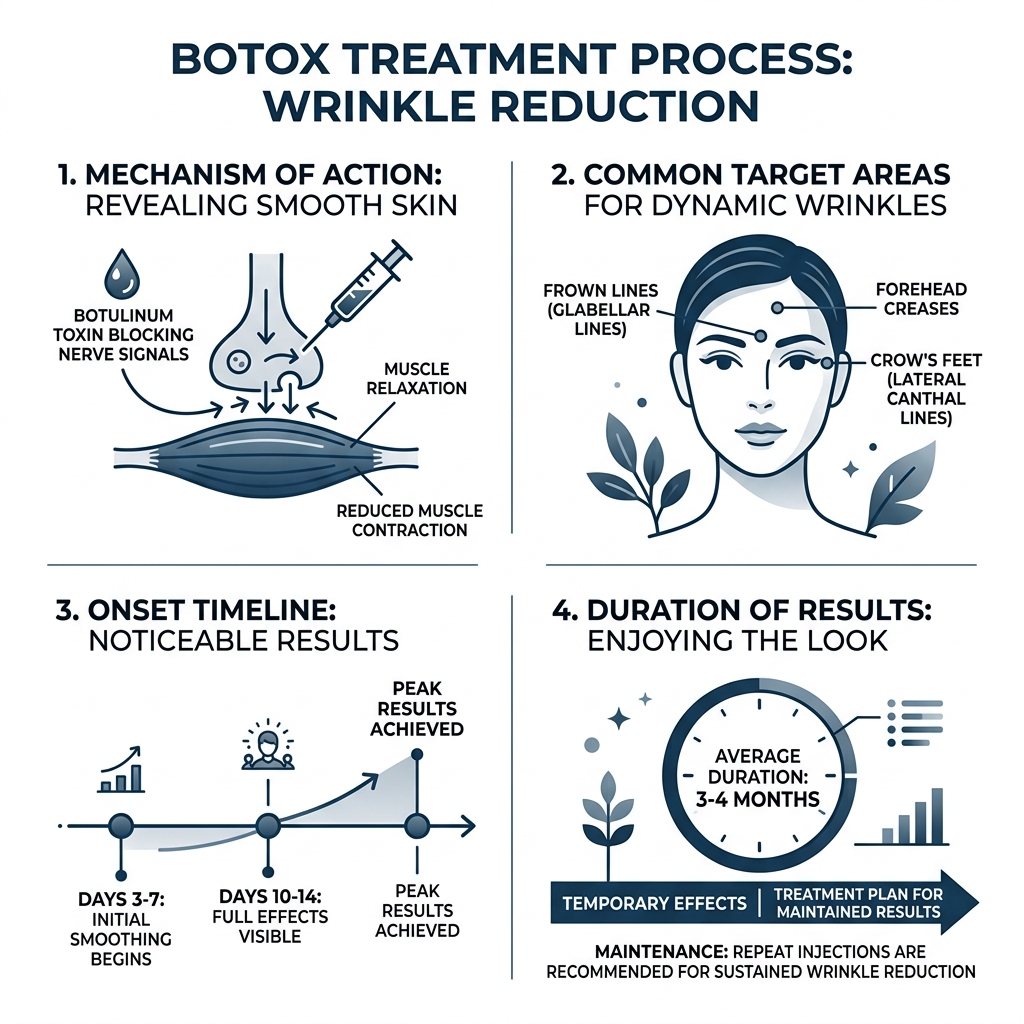
When we inject Botox into a specific muscle, it goes to work at the neuromuscular junction. It specifically targets a protein called SNAP-25. By cleaving this protein, Botox prevents the release of acetylcholine. Without that chemical “go” signal, the muscle stays in a relaxed state. This isn’t a permanent change; your body eventually builds new nerve endings, which is why the effects naturally wear off over a few months.
The history of this treatment is quite fascinating. While it was first used for medical conditions like lazy eye and neck spasms, its effectiveness for facial wrinkles was first formally reported in a 1994 study. The FDA officially approved it for cosmetic use on glabellar lines (the “11s” between your brows) in 2002, and for crow’s feet in 2013. Today, it remains the gold standard for non-surgical rejuvenation.
Understanding the Mechanism of Wrinkle Reduction Botox
We often call Botox a “neuromodulator” because it modulates, or adjusts, how your nerves and muscles communicate. This isn’t an instant process; it actually happens in four distinct stages within your cells:
- Binding: The Botox molecules attach themselves to the nerve endings.
- Internalization: The nerve cell “swallows” the toxin.
- Translocation: The toxin moves into the part of the cell where it can do its work.
- Blocking: The toxin cleaves the SNAP-25 protein, effectively “cutting the wire” so the nerve can no longer tell the muscle to move.
This precision is what allows us to soften a heavy frown while still letting you look like yourself. We aren’t freezing your whole face; we are simply quieting the specific muscles that cause the most distress to your skin. For many of our patients in Ashburn and Leesburg, this subtle approach is exactly what they are looking for. If you’re curious about how this differs from other brands, you can find more info about Botox and Dysport services on our dedicated treatment page.
Dynamic vs. Static: Identifying Treatable Wrinkles
One of the most important things we discuss during a consultation at ProMD Health Ashburn is the difference between dynamic and static wrinkles. Botox is a “hammer” designed for a very specific “nail.” If you try to treat the wrong kind of wrinkle with Botox, you might be disappointed with the results.
Dynamic wrinkles are the ones that appear when you are making an expression. When you smile, you see crow’s feet. When you’re confused, you see forehead lines. These are caused by muscle movement and are the primary target for wrinkle reduction Botox.
Static wrinkles, on the other hand, are there even when your face is completely still. These are caused by a combination of things: the natural loss of collagen and elastin, sun damage, smoking, and the gradual loss of facial volume. While Botox can help prevent these from getting deeper, it usually won’t make them disappear entirely once they are etched into the skin.
| Feature | Dynamic Wrinkles | Static Wrinkles |
|---|---|---|
| Cause | Repeated muscle contractions | Loss of elasticity, sun damage, gravity |
| Visibility | Only when making expressions | Present even when the face is at rest |
| Best Treatment | Wrinkle reduction Botox | Dermal fillers, laser resurfacing, microneedling |
| Examples | Crow’s feet, frown lines | Nasolabial folds, marionette lines |
Target Areas for Wrinkle Reduction Botox
Where exactly can we use Botox to help you look more refreshed? We focus on the areas where muscle movement is the most aggressive.
- Glabellar Lines: These are the vertical “11” lines between your eyebrows that can make you look angry or tired even when you’re happy.
- Crow’s Feet: The fine lines that fan out from the corners of your eyes when you smile or squint.
- Forehead Creases: The horizontal lines that form when you lift your eyebrows.
- Bunny Lines: The little crinkles on the bridge of your nose.
- Chin Dimples: Sometimes called “peach pit” chin, where the muscle creates a pebbled appearance.
While Botox handles the movement, we often find that our patients benefit from a “combination” approach. For example, if you have deep folds around your mouth, you might want more info about dermal fillers to restore lost volume in those areas.
We are also seeing a major trend in “Preventative Botox.” Many of our patients in their late twenties and early thirties are starting treatments before deep lines even form. By relaxing the muscles early, we can actually prevent dynamic wrinkles from ever turning into permanent static ones. It’s much easier to prevent a wrinkle than it is to fix one that has been there for ten years!
Comparing Botox to Non-Surgical Alternatives
We often get asked if there are other ways to get these results without an injection. While there are plenty of options, they generally work differently.
Dermal Fillers: As mentioned, these “fill” in lines rather than relaxing muscles. They are great for the lower face, whereas Botox is usually king of the upper face.
Microneedling: This is a fantastic way to boost your skin’s overall health. By creating tiny micro-injuries, we trigger your body’s natural healing response to produce more collagen. You can find more info about microneedling if you’re looking to improve skin texture and tone alongside your Botox treatments.
Topical Peptides (Argireline): You may have heard of “Botox in a jar.” Compounds like acetyl hexapeptide-8 (Argireline) are popular in skincare. While studies show they can help—one study showed a 30% reduction in wrinkle depth after 30 days—they simply cannot reach the muscle with the same potency as an injection. Interestingly, Argireline’s toxicity is about 4,000 times lower than Botox, making it a safe topical addition, but it’s not a replacement for the real thing.
Facial Exercises: Some people swear by “face yoga.” However, a study on facial exercises for rejuvenation suggests that while they might improve some areas like the forehead or nasolabial folds after several weeks of intense daily practice, they lack the clinical “punch” of Botox. In some cases, over-exercising facial muscles could actually make dynamic wrinkles worse!
The Treatment Experience: Results and Safety
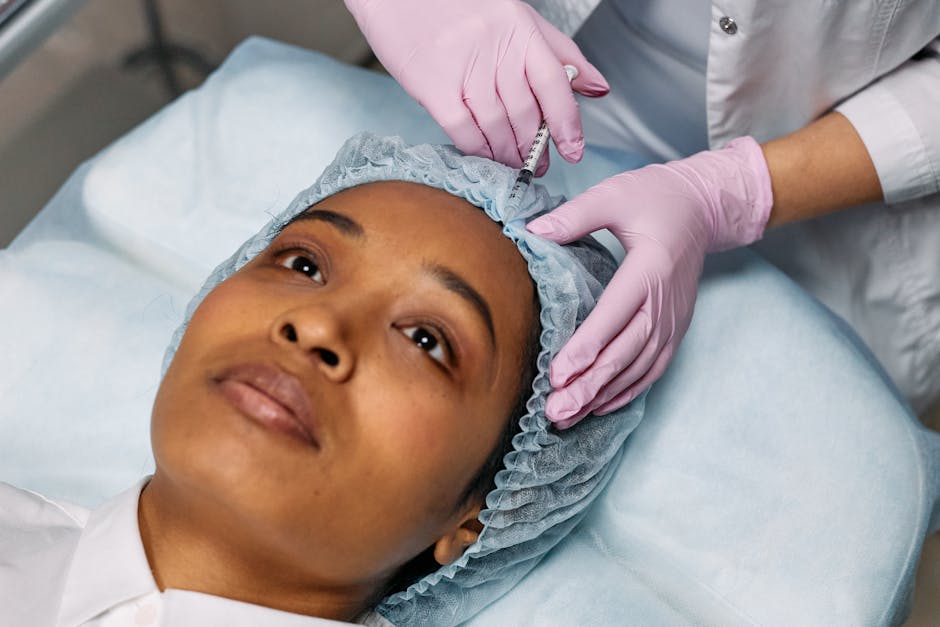
If you’re nervous about your first appointment, don’t be! A typical wrinkle reduction Botox session at our Ashburn office is remarkably quick—often less than 15 to 30 minutes.
We start with a thorough consultation. We look at your facial anatomy, the strength of your muscles, and your goals. We use a very fine-gauge needle (about the size of a strand of hair) to minimize any discomfort. Most patients describe the feeling as a quick “pinch” or a bug bite.
Dosage is key to getting a natural result. The standard cosmetic dose for the glabellar area is typically 20 units. However, we customize this for every patient. Men, for example, often have much stronger facial muscles and may require closer to 40 units to achieve the same smoothing effect. This is backed by a dose-ranging study of botulinum toxin which found that higher doses are often more effective for those with greater muscle mass.
Expected Results and Longevity
One of the most common myths is that you’ll walk out of the office with a perfectly smooth forehead. Botox takes a little time to “settle in.”
- Days 1–4: You might start to feel a slight “tightness” as the Botox begins to bind to the nerve endings.
- Day 7: Most patients see a significant visible improvement by the end of the first week.
- Day 14: This is the “gold standard” for results. We always recommend waiting a full two weeks to see the peak effect.
- Months 3–4: This is the typical duration for most people. As your body metabolizes the protein, muscle movement will gradually return.
To maintain that smooth, youthful look, we usually recommend repeat treatments every 3 to 4 months. Interestingly, some research suggests that if you stay consistent with your treatments for a year or more, the muscles can actually “train” themselves to relax, and your results might start to last a bit longer. We also highly recommend more info about medical-grade skincare to protect your investment; sun protection and high-quality antioxidants help maintain the collagen that keeps your skin resilient.
Safety Profile and Contraindications
Botox is incredibly safe when administered by a licensed professional like Aisha Hasan, PA-C or George Gavrila, M.D. It has a very broad safety margin. To put it in perspective, the lethal dose (LD50) in humans is estimated at 40 Units per kilogram of body weight—meaning a 150lb person would need thousands of units at once to reach a dangerous level. We typically use fewer than 50 units for a whole face!
However, like any medical procedure, there are potential side effects:
- Bruising/Swelling: This is the most common and usually fades in a few days.
- Headache: Some patients experience a mild “Botox headache” for 24 hours after treatment.
- Eyelid Ptosis: This is a rare (about 1-5% of cases) drooping of the eyelid. It usually happens if the Botox migrates too close to the eye muscle. The good news is that it’s temporary and can often be treated with special eye drops.
There are also specific research on Botox contraindications that we take very seriously. You should avoid Botox if:
- You are pregnant or breastfeeding (there isn’t enough research to prove it’s safe for the baby).
- You have a neuromuscular disorder like Myasthenia Gravis, ALS, or Multiple Sclerosis.
- You have an active infection at the injection site.
- You have a known hypersensitivity to any of the ingredients in Botox.
Frequently Asked Questions
How long does it take for Botox to work?
While some people notice a change in 48 hours, most visible results appear between 3 and 7 days. You won’t see the full, final effect until about 10 to 14 days after your appointment. If you have a big event like a wedding or a reunion in One Loudoun, we recommend scheduling your treatment at least two to three weeks in advance to make sure you’re looking your absolute best. While you wait for your results, many of our patients also enjoy more info about B12 shots for an extra boost of energy and wellness.
Does the injection process hurt?
Most of our Ashburn patients are pleasantly surprised by how little it hurts. We use the smallest needles available, and the actual injection only takes a few seconds per site. It feels like a quick pinch. If you’re particularly sensitive, we can apply a topical numbing cream beforehand, but most people find they don’t need it. It’s certainly less intense than something like more info about IV therapy, which involves a standard needle for a longer duration.
What should I avoid after my treatment?
Aftercare is simple but important to prevent the Botox from migrating to muscles we didn’t intend to treat:
- The 4-Hour Rule: Stay upright for at least 4 hours. No lying down for a nap!
- No Exercise: Avoid strenuous workouts for 24 hours. Increased blood flow can move the product around.
- Don’t Rub: Avoid massaging or rubbing the treated areas for at least 12 hours.
- Alcohol: Try to skip the wine for 24 hours to minimize the risk of bruising.
If you’re planning a full “glow up,” just remember to space out your treatments. If you’re looking for more info about chemical peels, we usually recommend waiting at least a week after your Botox to let the injection sites fully heal.
Conclusion
At ProMD Health Ashburn Med Spa, we believe that aesthetic medicine is an art as much as it is a science. Our team, including Aisha Hasan, PA-C, George Gavrila, M.D., and Madelyn Quigley, is dedicated to providing personalized care that respects your unique facial structure. We don’t believe in “frozen” faces; we believe in results that make you look like you’ve had the best night’s sleep of your life.
One of the things that truly sets us apart in the Ashburn and Belmont VA area is our use of the Entity Med AI Simulator. This incredible tool allows us to provide a personalized outcome visualization before we even pick up a needle. You can see a preview of your results, giving you total confidence in your treatment plan.
Whether you’re looking to soften those “11” lines or you’re interested in preventative aging, we are here to help. Our office is conveniently located at 20110 Ashbrook Place, Suite 270, Ashburn, VA 20147, serving patients from Lansdowne, Leesburg, and across Northern Virginia.
Ready to see what wrinkle reduction Botox can do for you? Schedule a consultation for wrinkle reduction Botox at ProMD Health Ashburn today and take the first step toward a smoother, more confident you!